

How to Hire AI Engineers in India 2026: A Guide for Global Companies
Artificial intelligence is no longer limited to experiments and pilot projects. As more global companies look to hire AI engineers in India, AI is being built into real products and everyday business operations. Companies use it for search, recommendations, forecasting, automation, generative AI applications, and smarter software features. This has increased the need for engineers who can take AI beyond a prototype and make it work reliably in production.
India has become an important hiring market for global companies looking for this expertise. The country offers a large software engineering base and a growing pool of professionals working in machine learning, generative AI, data engineering, MLOps, natural language processing, and computer vision. This breadth of technical expertise makes India particularly relevant for companies building or expanding AI-focused engineering teams.
But having access to a large talent pool does not automatically make hiring easier. Companies still need to identify candidates with the right combination of technical depth and practical experience. AI roles can be highly specialized, and job titles often overlap. More importantly, there is a clear difference between someone who has worked with AI tools and an engineer who has actually built, deployed, and maintained AI systems in production.
For CTOs, founders, and talent leaders hiring AI engineers in India, getting the role right is the first step. Start with the problem you need the engineer to solve. The required skills, experience, and technologies should follow from there. This problem-first approach can help companies find engineers whose capabilities are better aligned with the actual product, engineering, and business requirements of the role.
Get Top AI Engineering Talent for Up to 75% Less
Build your offshore AI engineering team in India with highly skilled, pre-vetted talent.
- ✓ AI/ML Engineers
- ✓ LLM & GenAI Experts
- ✓ Faster Hiring
- ✓ Lower Costs
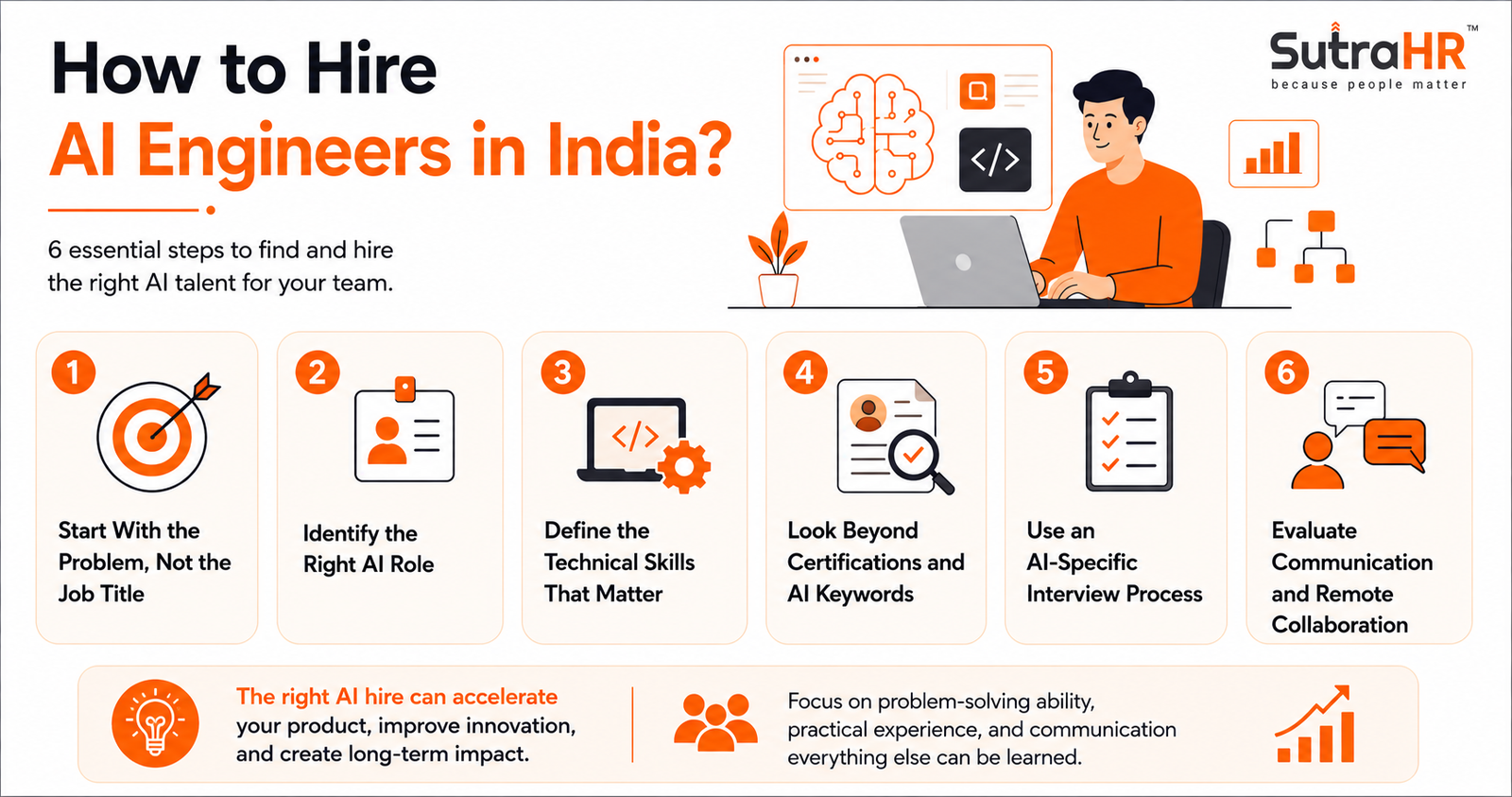
How to Hire AI Engineers in India?
Here are the 6 essential steps to find and hire the right AI talent for your team.
1. Start With the Problem, Not the Job Title
- Before opening an AI position, define what the engineer will actually build.
- A company developing an LLM-powered customer support product will require different expertise from one building a computer-vision inspection system or a predictive maintenance platform.
- The requirement may involve generative AI, recommendation engines, NLP, forecasting, computer vision, fraud detection, intelligent automation, or predictive analytics. Each area requires a different combination of engineering and domain knowledge.
- This distinction helps narrow the search and prevents companies from interviewing candidates whose experience doesn’t match the product’s actual requirements.
2. Identify the Right AI Role
- “AI engineer” is increasingly used as a broad term, but several roles sit within an AI engineering organization.
- An AI engineer generally builds AI capabilities into products and production applications. A machine learning engineer focuses more on model development, training, optimization, and deployment. A data scientist may focus more heavily on data exploration, statistics, experimentation, and modelling.
- An MLOps engineer concentrates on the infrastructure required to deploy, monitor, and maintain models reliably. Companies developing generative AI products may instead require LLM or generative AI engineers with experience in retrieval-augmented generation (RAG), embeddings, vector databases, model evaluation, fine-tuning, and LLM APIs.
- Defining this distinction before recruitment makes both sourcing and technical evaluation more accurate.
3. Define the Technical Skills That Matter
- The required technology stack should follow the product requirements rather than becoming a long checklist.
- Common skills for AI/ML positions include Python, SQL, machine-learning fundamentals, PyTorch or TensorFlow, scikit-learn, APIs, cloud platforms such as AWS, Azure, or GCP, Docker, and deployment practices.
- For generative AI positions, relevant experience may include LLM APIs, RAG architectures, embeddings, vector databases, prompt design, evaluation frameworks, and fine-tuning – skills candidates increasingly build through generative ai courses alongside on-the-job experience.
- A candidate does not need every technology associated with modern AI. What matters is whether their experience aligns with the systems your company intends to build.
4. Look Beyond Certifications and AI Keywords
- AI resumes can contain an impressive number of frameworks, models, certifications, and even a masters in ai. These are useful signals, but they should not replace evidence of practical engineering ability.
- Ask what the candidate has actually built. Have they deployed a model into production? How did they measure its performance? What happened when the quality of incoming data changed? How did they address latency, cost, or scalability? Did they monitor the model after deployment?
- For senior engineers, architecture decisions, debugging ability, trade-off analysis, and ownership of production systems can reveal far more than the number of AI tools listed on a CV.
5. Use an AI-Specific Interview Process
- A practical hiring process can include an initial screening, technical interview, focused assessment, engineering discussion, and final team interview.
- The technical stages should reflect the real work involved in the role. A GenAI engineer, for example, might be asked how they would evaluate a RAG pipeline, reduce hallucinations, or control inference costs. An ML engineer may be evaluated on data preparation, model selection, deployment, and monitoring.
- Avoid making the assessment unnecessarily academic unless the position genuinely requires research-level expertise.
6. Evaluate Communication and Remote Collaboration
- When hiring Indian AI engineers for an international team, technical ability is only part of the evaluation.
- Candidates should also be able to document decisions, explain technical trade-offs, communicate blockers, and work effectively with product managers and engineers in other locations.
- This becomes particularly important when the team works asynchronously or has only a few overlapping working hours each day.
Why Are Global Companies Hiring AI Engineers in India?
India’s attractiveness for AI hiring is closely connected to its broader technology ecosystem. The country has spent decades developing software engineering capabilities through IT services, product companies, SaaS businesses, startups, and multinational technology centers.
India’s wider technology ecosystem is also helping accelerate the growth of AI talent in India.
Bengaluru and Hyderabad continue to be major technology hubs. Pune, Chennai, Delhi NCR, and Mumbai also have strong engineering talent pools. Remote hiring has expanded the options even further. Companies no longer need to limit their search to candidates living in one particular city.
Indian engineers also bring experience from a wide range of industries. This includes fintech, healthcare, SaaS, e-commerce, manufacturing, logistics, cybersecurity, and enterprise technology. For global employers, this means access to professionals who often understand both the technical side of development and how software is used in real business environments.
Experience with global teams is another advantage. Many Indian technology professionals already work in English-speaking environments and collaborate with colleagues, clients, and stakeholders across different countries and time zones.
At the same time, good AI talent is not simply waiting to be hired. Experienced AI and ML professionals are in strong demand within India too. Companies need competitive offers, clear roles, and a well-managed hiring process if they want to attract and secure the right candidates.
Get Top AI Engineering Talent for Up to 75% Less
Build your offshore AI engineering team in India with highly skilled, pre-vetted talent.
- ✓ AI/ML Engineers
- ✓ LLM & GenAI Experts
- ✓ Faster Hiring
- ✓ Lower Costs
How Much Does It Cost to Hire an AI Engineer in India?
There is no single reliable salary figure that applies to every AI engineer in India.
Compensation varies considerably according to experience, specialization, city, company type, and the complexity of systems the engineer has previously built.
Junior AI/ML engineers may have strong programming and modelling foundations but require guidance on production systems. Mid-level engineers are more likely to independently develop features, integrate models, and contribute to deployment.
Senior AI engineers generally command significantly higher compensation because employers expect them to make architecture decisions, solve production problems, and mentor other engineers.
Specialized expertise can create another premium. Engineers with strong experience in LLM architecture, MLOps, computer vision, advanced NLP, or large-scale ML infrastructure may earn substantially more than general market averages.
Global employers should therefore treat salary reports as market indicators rather than fixed hiring rates.
The actual cost of employment should also be considered beyond base salary. Depending on the employment structure, employers may need to account for benefits, statutory obligations, recruitment, equipment, onboarding, payroll administration, and retention.
India can provide meaningful cost efficiency compared with several Western technology markets, but the strongest AI professionals should still be treated as premium technical talent rather than inexpensive labor.
Benefits of Hiring AI Engineers in India
One of the biggest benefits is access to a broader engineering ecosystem rather than AI talent in isolation.
An AI product may eventually require data engineers, backend developers, cloud engineers, MLOps specialists, data scientists, and DevOps professionals. India’s technology market can support recruitment across these complementary disciplines as the team grows.
Companies can also access a wide range of specialisations, from traditional machine learning and predictive analytics to NLP, computer vision and generative AI.
Another advantage is scalability. A startup might initially hire an AI engineer or senior ML engineer and subsequently expand into a multidisciplinary AI team as the product develops.
Cost efficiency remains relevant, particularly for global companies comparing engineering markets. However, it should be considered alongside capability, retention, and productivity. Hiring an inexpensive candidate who cannot take an AI system into production rarely creates a genuine cost advantage.
India is also well suited to long-term remote engineering arrangements. Instead of viewing Indian AI professionals solely through an outsourcing model, companies can build full-time distributed teams in which engineers become part of the organization’s ongoing product and engineering function.
Building a Remote Team of Full-Time AI Engineers in India
Building an AI team requires slightly different planning from hiring a single engineer.
Where possible, companies establishing a new AI function should consider making an experienced technical hire early. A senior AI or ML engineer can help define architecture, technical standards, model evaluation practices and infrastructure requirements while also helping assess subsequent hires.
The eventual team structure should follow the product.
A growing AI organisation may include AI engineers, ML engineers, data engineers, MLOps specialists, backend engineers and data scientists. Not every company needs all these roles from day one.
Remote engineering processes also need to be deliberate. Teams should have established code-review practices, documentation standards, Git workflows, project-management systems and clear technical ownership.
Security deserves particular attention where engineers work with proprietary datasets, customer information or commercially sensitive models. Access permissions, development environments, cloud credentials and data-handling policies should be defined before onboarding.
Retention is equally important. Skilled AI professionals have expanding career options, so competitive salary alone may not be sufficient. Technically challenging work, ownership, capable leadership, career progression and opportunities to deepen specialised expertise can all influence retention.
Common Mistakes When Hiring AI Engineers
One common mistake in AI hiring is treating “AI engineer” as a universal job description. A vague role attracts a broad candidate pool but often makes technical screening more difficult.
Another is creating an unrealistic technology checklist. Expecting one engineer to be an expert in data science, backend engineering, cloud architecture, MLOps, ML research and every new GenAI framework can eliminate otherwise strong candidates.
Companies should also avoid evaluating candidates solely through theoretical machine-learning questions. Production AI combines model knowledge with software engineering, deployment, observability, security and practical problem-solving.
Equally important is hiring speed. Strong AI/ML professionals may be speaking with several employers at the same time. Excessively long interview processes or unclear decision-making can result in companies losing suitable candidates before an offer is made.
How SutraHR Helps Companies Hire AI Engineers in India
For international companies, hiring AI talent in India can take time. This is especially true for businesses that are new to the Indian technology market. Finding candidates is only one part of the process. Companies also need to identify the right skills, screen relevant profiles, and understand whether a candidate’s experience actually fits the role.
SutraHR helps global companies identify and hire AI engineers in India based on their technical requirements and hiring goals. The focus is on finding professionals whose experience is relevant to the work the company needs them to handle.
As an AI recruitment agency in India, SutraHR can support different stages of the hiring process. This can include understanding the role, identifying relevant talent, sourcing candidates, and carrying out onboarding. Support can also extend to interview coordination, compensation discussions, and the offer stage.
This becomes particularly useful when a company needs specialized AI talent but does not have an established recruitment team in India. Hence, employers can access the Indian talent market without having to build the entire sourcing process from the ground up.
The requirement may be for one AI engineer, a machine learning specialist, or several professionals for a growing engineering team. In each case, the objective remains the same. Companies need candidates with experience that matches the actual work they will be expected to perform.
Frequently Asked Questions
1. Is India a good place to hire AI engineers?
Yes. India has a large technology workforce and a growing pool of professionals working across AI, machine learning, data engineering, and related areas.
However, experienced AI specialists are also in strong demand. Employers therefore need focused sourcing, competitive compensation, and a hiring process that does not take unnecessarily long.
2. What skills should I look for in an AI engineer?
Start with strong programming fundamentals and relevant machine learning knowledge. Depending on the role, this may include Python, ML frameworks, cloud platforms, APIs, data handling, and model deployment.
Practical experience matters just as much. Therefore, look at what candidates have actually built, deployed, or maintained rather than relying only on certifications and technologies listed on a resume.
The final skill set should always reflect your product and the problems the engineer will be solving.
3. Can companies hire remote AI engineers in India?
Yes. Many Indian engineers already work with distributed teams and international companies. Remote hiring can therefore give employers access to talent across India instead of limiting recruitment to one technology hub.
Companies should still establish the basics from the beginning. Clear communication practices, working-hour overlap, security requirements, documentation, and defined responsibilities can make remote collaboration much smoother.
4. Can startups hire AI engineers in India?
Yes. India can be a useful hiring market for startups that need specialised AI expertise without building a large engineering team immediately.
A startup may begin with one experienced AI or ML engineer and expand as the product develops. It can later add data engineers, MLOps specialists, backend engineers or other technical roles as required.
For startups, however, the first few hires matter considerably. Therefore, candidates should be assessed not only for technical skills but also for ownership, adaptability and their ability to work in a fast-changing environment.
Get Top AI Engineering Talent for Up to 75% Less
Build your offshore AI engineering team in India with highly skilled, pre-vetted talent.
- ✓ AI/ML Engineers
- ✓ LLM & GenAI Experts
- ✓ Faster Hiring
- ✓ Lower Costs
Conclusion
India gives global companies access to a large and increasingly specialized AI engineering talent pool. However, successful AI recruitment in India involves much more than searching for candidates who have AI tools and frameworks listed on their resumes.
The first step is to understand what the business actually needs. From there, companies can define the right role, identify the required technical skills, and assess candidates based on relevant, hands-on experience.
Compensation and hiring speed also matter. Strong AI and ML professionals have several opportunities available to them. Companies therefore need competitive offers and a recruitment process that is clear, practical and reasonably quick.
For organizations looking to hire AI engineers in India, SutraHR can help identify and recruit AI and machine learning professionals who match the company’s technical requirements, experience expectations, and longer-term hiring plans.